Basic HTML Version


TREMENDOUS ADVANCES HAVE been made
in the care of heart patients during the past two
decades. One of the most commonly performed
procedures is cardiac catheterization, in which
catheters—small hollow tubes—are used to
diagnose and treat heart blockages.
In the past, almost all of these procedures
were performed using the femoral artery,
which runs through the groin area. Using the
femoral artery, however, can create discomfort
for patients, who must lie flat on their backs for
hours after the procedure. In addition, there
are increased risks of bleeding complications
when the femoral artery is used, creating the
potential for additional patient discomfort and
prolonged hospitalization.
It’s all in the wrist
Because of these drawbacks, cardiologists
have developed techniques for performing
catheterization procedures using the radial
artery, which runs through the wrist.
After radial procedures, patients can
sit up immediately and may be discharged
much sooner than before. Not surprisingly,
research has shown that patients
overwhelmingly prefer radial to femoral
procedures.
Not all patients can have cardiac
catheterizations performed this way and some
procedures are still best performed using
femoral access. In many countries, however,
the majority of catheterization procedures are
now performed using the radial artery.
Advanced care, right here
Cardiologists at Sacred Heart have been
leaders in the adoption of radial procedures.
A
new
approach
The radial program was started in 2002 and
during the last five years, physicians have
performed more than 2,500 procedures.
In addition, the outpatient Cardiology
Diagnosis and Treatment Center at Sacred
Heart offers a dedicated recovery lounge
where radial patients can sit in a recliner
immediately after their procedure to watch
TV, visit with family or use their laptops until
discharge.
This most recent innovation is part of an
integrated, multidisciplinary approach within
the Oregon Heart & Vascular Institute to
pioneer noninvasive and minimally invasive
treatments for heart disease, vascular disease
and stroke.
For more information, visit us online at
www.peacehealth.org/ohvi
.
Cardiologists make catheterization procedures more comfortable for patients
Heart health
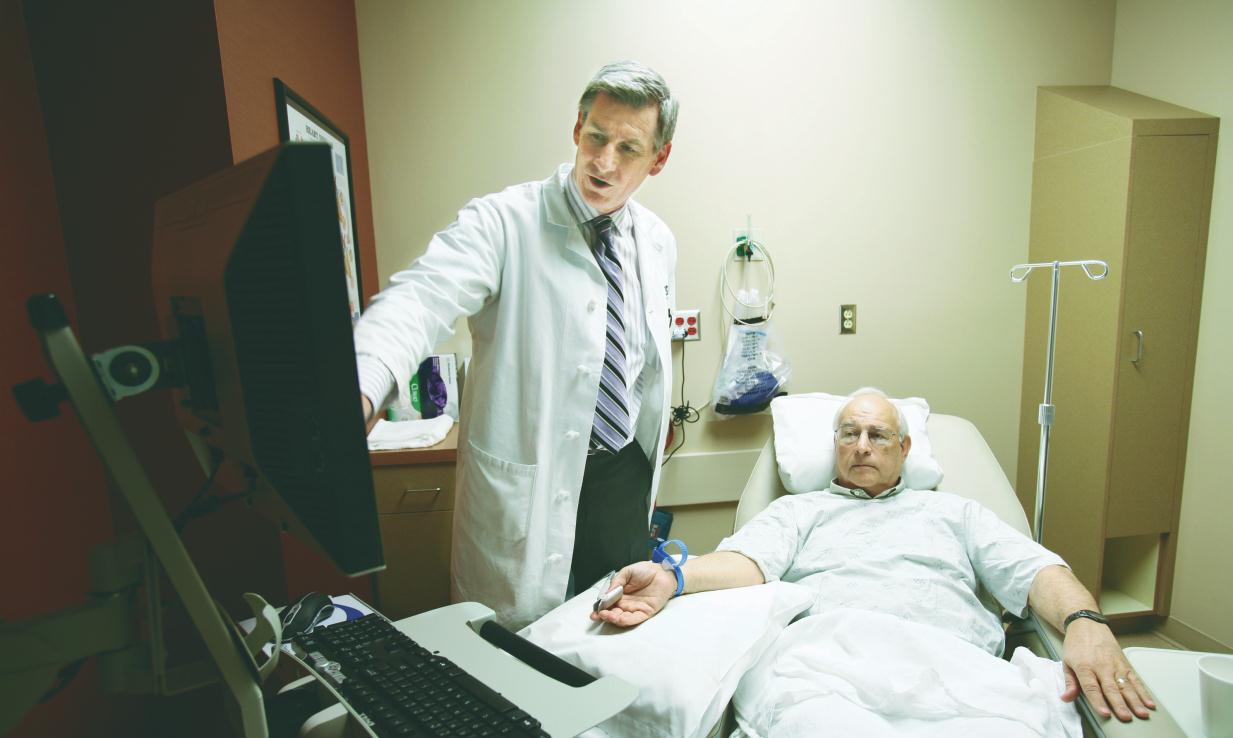
Stephen Cook, MD, cardiologist
with Oregon Cardiology at Sacred
Heart and founder of the hospital’s
radial access program, speaks to a
patient in the recovery lounge at
Oregon Heart & Vascular Institute.
www.peacehealth.org
7